I have reads that thread, but am pretty sure, that this is not the full truth.
There is no way a modern CPU is used up to 60-70% CPU load just to generate thumbnails (or whatever!)
Also I do not care about the differenciation of this thread between “into detection” and “thumbnail creation”. Because what I see on my CPU is this:
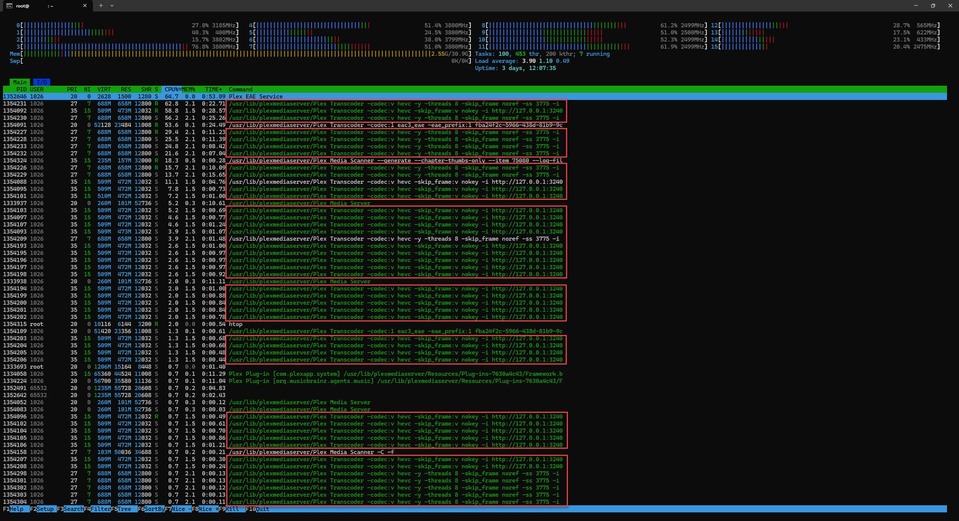
(sensible info censored)
Which is clearly showing, that the CPU is handeling Plex own fork/compilation of FFmpeg.
But everything that runs on FFmpeg can be proccessed by the GPU.
There should not be any discussion about this - this is a fact. This is doing transcoding work. Not anything else, mentioned in the thread you mentioned.
Please do not talk down this topic/thread, or reference to other threads - I have done my due diligence to do my research before posting.
- This load is not normal
- No I dont just want to generate these thumbnails on period, but when added
- When added (actually when the work has to be done) the work is done super inefficient.
Such load (as also mentioned in the other thread) can be offloaded to the GPU/QuickSync and does not need to run to 100% on CPU.
Also: ALL what was mentioned in the other thread, would not even trigger a load of more than 5% of any modern CPU. Reading and writing to DB… does NOT have anything to do with CPU load, but with I/O.
This basically is a lose and meaningless statement, which is true, but does not have ANYTHING to do with the CPU load in the mentioned thread. Nor in my thread here. Reading and writing to any DB, does not trigger any visible/noticable CPU load.
The screenshot I have proved proves: there is transcoding work beeing done in the CPU!
This high CPU load just occured since I activated thumbnail generation. I now have the very same settings as before (intro/outro identification etc.) the only thing that changed is the activation of thumbnail generation and immediately got high CPU load.
