Maybe this is all about Licensing.
x265 - an open source implementation for encoding to HEVC/H.265. It has a GPL license and it free to use by anyone
See:
Would that include the approval process of apps sold in there app stores by the said vendors
Yes, open source is open source.
Plex already uses the x264 encoder for the H264 transcoding.
You can find them in your “Plex Media Server\Codecs” folder.
It’s not the encoder that is the problem, it is the work that the plex developers will need to do to edit the python scripts, the device profile XML’s and the trancoding profiles for ffmpeg.
Its a question of time/priority I guess.
Of course it will also affect the people using old hardware like an old NAS, so Plex will have to stop supporting these or they will have to detect the hardware some how to be able to see if it can support HEVC, if so transcode to HEVC.
It will involve a lot of work but even just implimenting the encoder will be a step in the right direction I think, maybe a beta channel for HEVC.
The fact that an algorithm is open sourced, does not mean that there is no intellectual property in there, which requires licensing and payment of royalties.
The H.265 codec may be freely usable in an opensource project (under certain conditions), but if you use the codec in your own projects, you will be contacted by the owners of the intellectual property, eventually.
Read up on the main reasons why AV1 was developed. All that effort was not taken just for fun.
Saying 4K is the new standard does not change the fact that it requires a lot to encode/decode it.
4K might be the new standard, but that is a half-baked argument if you only focus on pixel density.
Remember that not all 4K is the same. The 4K you get from a UHD Blu Ray has a LOT higher bitrate (more data) than the same movie streamed from your online platform of choice. They might have the same pixel density, but the quality is NOT the same. These online platforms have a much smaller bitrate than what you find on a disc.
What is the point of having 4K if you are going to compress it to the point where it looks like a potato filmed it. It will look super blocky, but at least those blocks are in 4K resolution 

(extreme point, but even at a low compression rate, compression artifacts/loss of quality will start showing up)
Edit: I am thinking specifically on 4K–>4K compression to achieve a smaller bitrate. I agree and understand you will get better quality going 4K–>1080p as opposed to the HD Blu Ray source, but that brings in the argument of tone mapping HDR, which tbh I’m not sure what the state of tone-mapping is in Plex. But still 4K “requires a lot to encode/decode it.”
Here is an informative video showcasing the quality between streaming 4K, and 4K Blu Ray
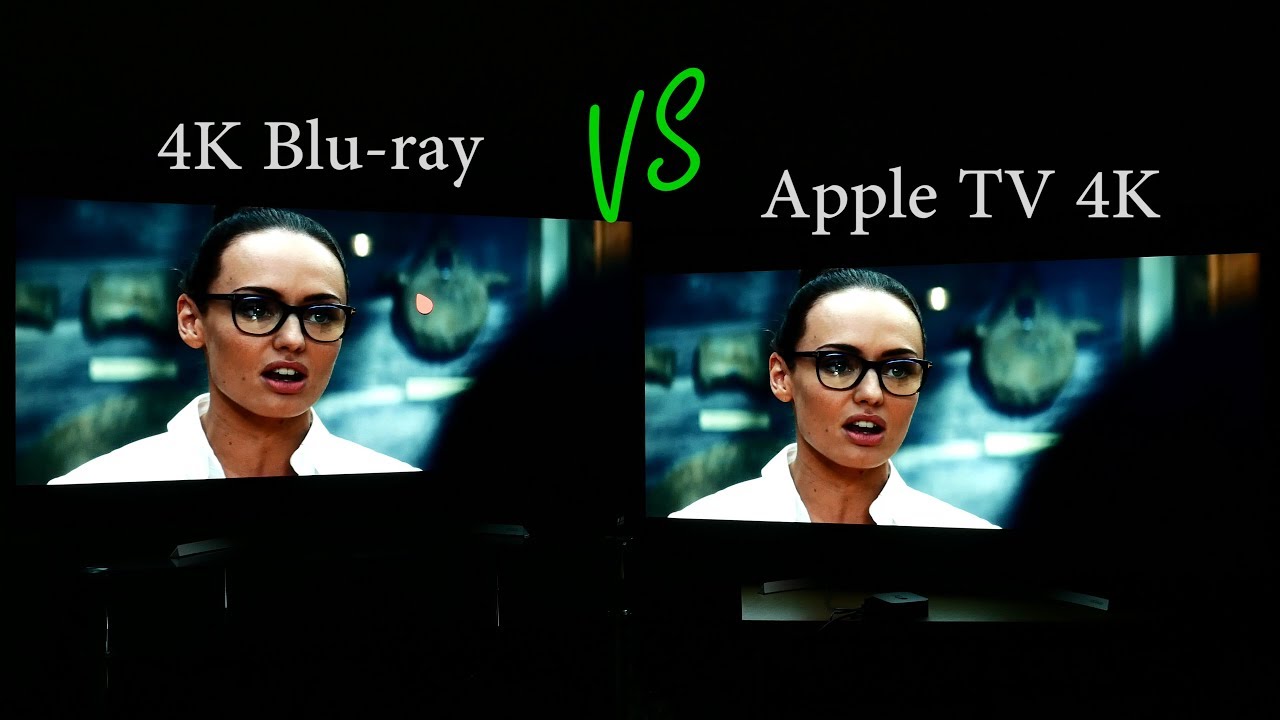
This is nothing new in the realm of players, a Xbox One’s UHD Blu Ray Player will not reproduce an image to the same quality as an Oppo (rest in peace.) It might look better on your TV player than the shield, but since you have a bandwidth issue on the TV, I would still not consider it as meeting rules 5 and 8 (Wifi is not reliable enough/have the bandwidth headroom [right now that is] to repeatedly play back 4K without hiccups.)
Sorry for derailing a discussion. I think Plex should incorporate x265 into it’s transcoding engine, but I would still not recommend transcoding 4K content. What’s the point in having a high quality source like 4K if you are going to reduce it?
So the question that comes to mind, is it better than 1080P compressed 4K?
Answer: Generally yes IMO as the TV processor has less to do to adapt to the 4K panel resolution
Hey Scott, good point 
I will explain what the point is in getting high 4k media:
- Downscaling from the highest possible quality source still seems to retain the quality from the source.
- I have devices that can support the bandwidth and they get the highest quality stream, some devices like 4k smart TV’s do not but other devices in house do support these streams.
- Around 80% of UHD/4k steams are still below the 100mbps, these work fine with a 100mbps connection.
- I have contacted Samsung and LG about the 100mbps LAN connection problem in their TV’s, they did not see this as a problem because most people use downscaled streaming platforms like Netflix or YouTube but for the 8k TV’s Samsung told me that they are fixing this limitation. In other words 8k TV’s should be able to support a stream higher than 100mbps.
I am getting my content prepared for the future, why get your content and downscale it and put all that effort in and in a year start all over again because then all devices are ready to support 4k?
With 4k HEVC → 4k HEVC compressed downscaling I am also assuming that the 10-bit color will remain and then the whitewashed streaming issues will be a thing of the past
Please try to keep this feature request on topic, if ya’ll want to keep it alive.
Arguments, non-constructive, and off-topic feedback will be moderated accordingly to the posted guidelines.
Transcoding to HEVC would be so useful, even for local streaming
I had a file which was H265 with a reasonably low bitrate, which direct played perfectly without subtitles, however to turn on subtitles it had to transcode to H264, which meant the bitrate was too high and it kept buffering
I cant believe we are still waiting for this to be a thing, they give us awful Atari games but no H265/X265 Encoding support??
Honestly, even my video surveillance cameras encode in H265, saves me a huge amount of storage space.
Everything is using HEVC now, and most recent products support encode/decode now, most recent Intel CPU’s with QSV fully support H256 via hardware acceleration and I believe the GTX 1050 and up all support it as well.
It would make my 2mb 720p streams over the web look like 4mb 720p, and we could easily do 3 to 4mb 1080p streams, instead of the ridiculous 8mb 1080p streams we are limited to at the moment.
I’m all for implementing new ideas in Plex, but this is something people have been asking for for over 2 years now.
I can encode multiple H265 1080p streams with a Gen 9 Intel CPU at more than 30fps each, and I can easily do 4 720p streams, CPU doesn’t even break a sweat, and my aging GTX 1080ti can transcode a high bit rate 1080p H264 to a heavily compressed 1080p H265 in more than 200fps and the quality is almost as good as the original, and if you use an RTX card, the quality is even better.
Seriously, we don’t really need need Space Invaders or Centipede, we need H265 Encoding support, hell I don’t care if you say it will only work on “X” GPU or “Z” CPU, I will go and buy what ever I need to make it work.
I couldn’t agree more. It is absolutely pathetic on the part of the developers to not support this, without giving a reason, at this point in time. For them to stay completely silent on the matter is shameful.
I thought maybe they were waiting for newer cards to support AV1, but it looks like the GeForce 30 cards only do AV1 DEcoding, not ENcoding. x265 transcoding would be very nice to have for the litany of reasons already mentioned.
Why are people still asking for this for over 2 years and all is falling on def ears.
This definitely needs to happen, both NVENC and QuickSync have supported H265/HEVC encoding for more than a couple generations already, and both implementations are far superior than their H264/AVC output.
They should at least add a switch to enable it on supported hardware, if not enforcing it by default.
What is the status on this?
Honestly it does not make sense to not have this format which takes less bandwidth and storage space.
Two years after I made this thread and we still can’t even get someone to admit whether it’s on the roadmap or not, let alone give us any kind of timeline. 
But we have Plex arcade
Ding ding ding. There is no subscription revenue to be gained from from adding HEVC transcode support. 
Aw man what a waste of good developer time 
I think most can agree that we use plex for our media, not for gaming 
