The lack of this feature on the pi4 is definitely between me and a life time substciption. Please make it happen!
2 Likes
I have a plex pass and would really want this. pi4 is cheap and I would happily put plex on it, certainly with all the intel bugs around. I try to avoid intel for internet-connected machines …
Please also but this then in your docker-container as I run plex within docker for easy management. Tx! Looking forward to this…
Chuck, as a software dev myself, I completely understand your frustration with the community at large and the difficulty communicating in-house. It’s a very tricky path to weave and I have found your insights into the difficulties in supporting ARMv8 (specifically RPI4) quite insightful. Please don’t give up on us.
Thank you for trying to carry the flag. I also get how hard it is to move an engineering team when it looks like the ROI is minimal. Why the hell would a corporation invest thousands, if not tens of thousands of dollars in developer time into making a feature that has little to no return? Not likely.
Here’s the thing. The raspberry pi community is literally rabid. A $35-$75 computer that can perform as well as a Mac? Insane! The reality is, the ROI for supporting a lot of random partners for storage in various platforms (QNAP, Drobo, and Synolgy) literally pales in comparison to the equally nutty support of a platform like the RPI4 and attached NAS storage. The RPi is a phenom, and widely supported. It can attach any storage platform, can be inexpensive (just 4 flash drives) or expensive (a bunch of NAS Ethernet devices!)
Make it simple. Support one platform… and divest support for all storage onto that. You’ll crush it.
Literally sell this: Go get this board (rpi4), put this SD image in, and BOOM: any storage becomes a Plex media server!
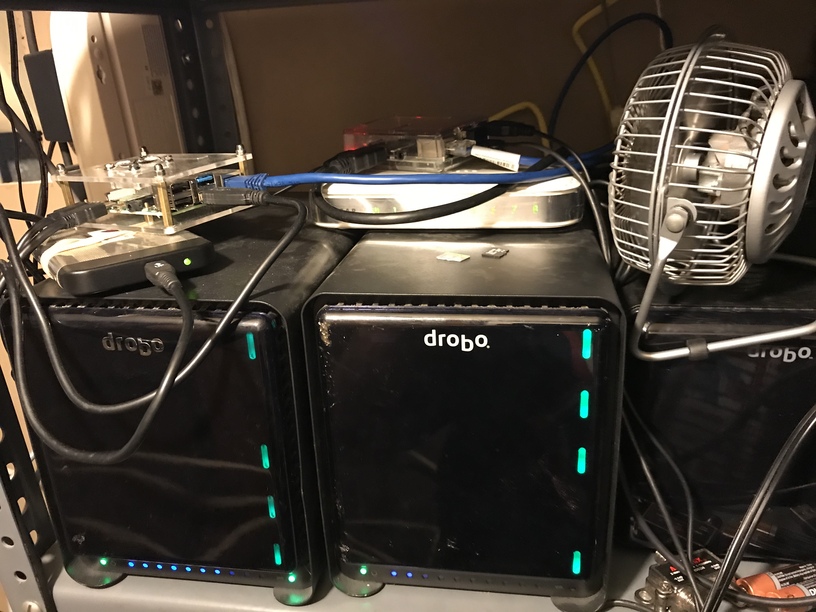
Here’s my setup, sloppy as it may be. A Drobo 1st gen, a DroboFS, and a Drobo5N, with a USB connected 1TB SSD. All attached to a truly incredible RPI4. (Rpi3 in the background for fun).
It could be a fun partnership too!
6 Likes
To clarify: partner with RPI, make a Plex branded case with an embedded $35 retail (likely $17 or less delivered) embedded device that can recognize nearly any networked or directly attached storage that has the hardware capability to transcode 1080p30 h.264 and even h.265 HW transcoding capability… Brand it “Plex Media Server Ultimate” bundled with your existing subscription or lifetime Pass model, and all you’d really need to develop in house is your existing media processing capabilities and the ability to mount any storage. Develop a simple GUI to find media and you’re there. Easy to maintain, easy to adapt to new storage systems as they emerge, universal…
Just sayin’.
Pretty sure the RPI folks would welcome the ability to sell units with you as well.
3 Likes
plex pass user here
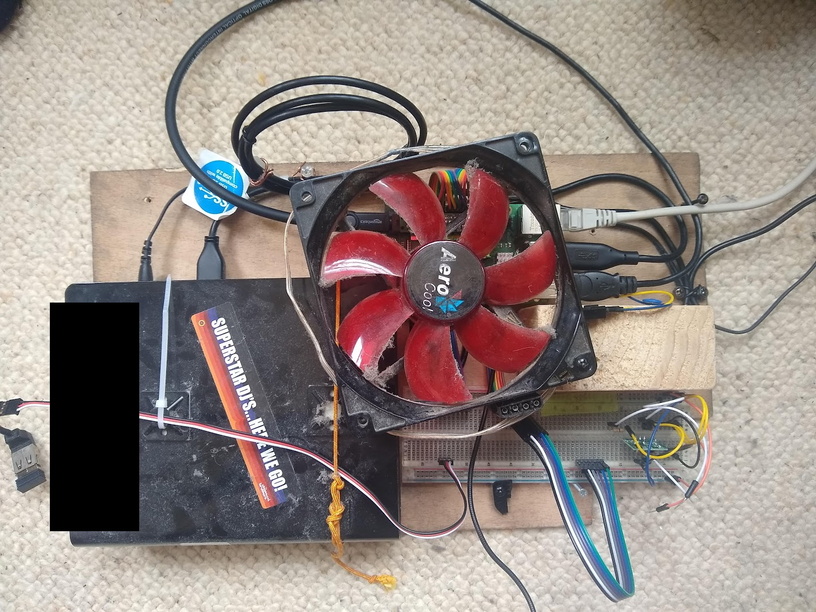
plex server on a pi4 its ganky but works this thread is giving me home for the server becoming more usalble. waiting on beta build now.
that and the headless plexamp /cross fingers
pic: filthy pi4 sever
2 Likes
They’re now focused on DVR (just read their last 20 release notes) which will bring the regular customer to their platform.
In my humble option, which a strongly believe, the owner is just paving the road to be acquired by some other big company.
They also do a lot for DVR but not only. You will see a lot of improvements (new scanner) and even new apps (Dash, Plexamp) which are being developed and have nothing to do with DVR.
As much as I like seeing another RPI rig pic, it’s unproductive to couple it with a criticism of perceived priorities on behalf of the Plex dev folks. You have no idea what the devs are tasked with, much less where the direction of the company may lie with upper management.
This thread is intended to encourage them to support the RPI4. Perhaps more fan pics of RPI rigs would be helpful! Please, all, post your pics too!
But stop poking the bear and try to be constructive. With Apple recently throwing their entire product line behind an ARM based architecture, this is a great time to be a tiny-ARMv8 hobbyist. I don’t care if riding apple’s coattails gets ARM HW support, as long as it gets there!
Chuck, please do disregard the snooty types… I’d love to hear your thoughts on my posts above.
1 Like
Also I’m shopping for a DVR module now… I do think they are leveraging correctly in assuming people are hurting right now and looking for a low-cost OTA solution. Enter Plex. Right on.
1 Like
Please allow me to make my duties clear.
- I am primarily tasked with Customer Support & QA.
- I have split duty with Engineering on the Linux systems implementations.
- I am directly responsible for:
a. Synology package
b. QNAP package
c. Debian & Redhat Linux packages. - I have other specific target tasking as directed by management (doing one now for a partner).
All of this is supposed to fit in my 20 hr/week schedule (I am part-time).
I end up working about 45-50 hours each week because folks in the forum need help.
While I am quite skilled in C & C++ (been a developer for 30+ years now), I don’t know the FFMPEG code base sufficiently to effect any changes to it. It’s a very complex and beautiful piece of work. I’d need about 6 months to gain any level of mastery/trust in my knowledge of it.
What may seem trivial is never as easy as it looks when dealing with this type of technology. FFMPEG and libVA (hardware transcoding) is extremely detail rich. If it were easy, Linux would have all the capabilities that Windows enjoys. Sure it’s easy to have github compare and merge code but what happens when there are unresolved conflicts? What about all the different CPUs and their ASICs? They are quite different (hence the i965 and iHD drivers). That’s what makes it interesting and requires skill.
As I’ve stated previous, I’ve made the transcoder team aware of this capability but, as I also stated, this is NOT a short turnaround lead time change.
4 Likes
I’m sorry that you’re not understanding what I’ve tried to communicate.
I am glad you were able to backport the code and have success.
Capitalizing on that success, which is something we’ve been wanting to do since the launch of ARMv8 support is having hardware transcoding, and, as you state, is no longer prohibitively licensed. Thank you.
Regarding what must happen from here, which I’m not sure I communicated clearly enough, is an involved process.
First, FFMPEG & the process of what we have to do to make this happen.
1 Yes, I’m aware of the effort required to integrate that work into our Transcoder isn’t a big deal.
-
I’m also painfully aware of all the other nuances which occur when we bump the transcoder to match upstream because –
-
We do not piece-meal the bump. We take all of it and then apply across the entire transcoder. This allows us to take advantage of both the work of others as well as the final integration of all the bug fixes we’ve sent back upstream for the FFMPEG team to review and disposition. Performing this full update bump keeps us compliant with GPL and makes submitting bug reports & fixes easier for all.
-
Regression testing is, and obviously must be, extensive. Even with such testing, there are always minor issues found when presented to the community as the “Forum Preview”. The Forum Preview period provides invaluable feedback in many ways.
-
When all the above have been iterated until issues are resolved or reduced to Engineering’s satisfaction, the final QA cycle begins.
-
Concurrent with this, any required changes to Plex Media Server and the players are set into motion.
-
When all the product teams are ready then it’s made available as Plex Pass beta.
How this pertains to other vendors products.
-
As all these changes are in flight, I also am involved because both Synology and QNAP utilize RealTek RTD 1293, 1295, and 1296 CPUs. I test engineering in-process work (unit testing) as well as “alpha”.
-
The player teams are usually involved to ensure there are no regressions.
a. If this were the situation where we’ve added full tone mapping of HDR, they would verify everything is per spec. -
Any issues I find get reported back to Engineering to be addressed just as with the product teams.
This is why making a change is such a “Big Issue” and involved process. (which I stated long ago but will quote again if needed).
You state
Everything that is required to be made available per GPL has been made available.
The rest of Plex’s source code is closed, proprietary, source, developed in house.
Per the referenced GPL below:
Ref:
https://support.plex.tv/articles/204096476-license-information/
PS: all of this information is available by searching this forum.
3 Likes
If you don’t like my answers, write to Plex corporate.
I don’t know who you think you are – entitled to everything but you’re done.
Have a good day.
3 Likes
Chuck,
I can only speak for myself but I just wanted to say that I do appreciate you taking the time to help us understand how things work. As I previously stated, especially with a product that supports so many platforms, it takes a lot to move even a little.
Don’t sweat the small stuff and thanks again for at least putting it out to the devs.
Regards,
Brian
4 Likes
Late to the thread but good technical info.
@ChuckPa I remember I did some tests a long time ago with ffmpeg built with openmax (omx) and a raspberry 2 was able to handle HW encoding to h264 in realtime
I don’t know if Plex uses an ffmpeg process or internalizes some libs, but I assume that OpenMax builds were also explored by engineering in terms of specific RPi encoding acceleration?
Thx!
PD: I’m also assuming that the user base of servers running on RasPis is a big number to justify it, of course
Tbh I don’t think so because it is so limited. And Plex will know the metrics. If it was so popular, more development would happen probably.
1 Like
Add me to the list of folk who are surprised h264_omx isn’t in there already. I’m currently using it to transcode a TiVo-supplied mpg2 by hand with ffmpeg and the speed is 1.02x… and I’m not trying to save time with it.
would love to have this enabled… plex on raspberry pi 4 is growing a lot, in fact the only reason that I am using plex is because I wanted something to use my raspberry pi for
I wonder if we have a Catch-22 situation here. PMS metrics don’t show enough people using PMS on RPi hardware to justify resources for adding HW support for the RPi. And on the other foot, no one wants to stick PMS on their RPi until there is hardware transcoding support.
I think a 4 GB RPi 4 would make a very sweet little Plex server. I would love to see this feature added to Plex.
3 Likes
+1 Rpi4 8GB user here.
1 Like
I’m actually considering getting an RPi 4 to replace the old MacBook Pro that was running my Plex server and died the other week. Hardware transcoding support would be amazing.
3 Likes
