hi!
is there a way to have multiple artists nowadays? i dont know how people considering using a software which cant handle this for a serious music library. is emby able to do it?
cheers!
Yes, Emby does this. I have an album of The Manhattan Transfer, and nearly every track has a guest, including Frankie Valli, Felix Cavaliere, and others. Emby creates an Artist page for those guest artists, even if I have nothing else from them.
Emby screenshot:
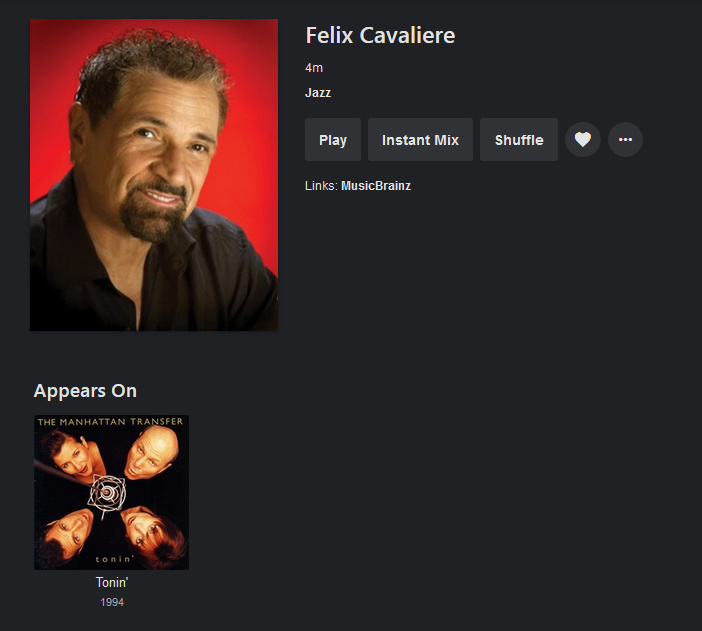
4 Likes
That’s really sweet. I will try it out.
There’s a feature request for this.
1 Like
Has there been any feedback from Plex devs if any of this is being actively developed?
Useful as this topic is to get attention, I believe that for practical development purposes this topic can be broken down into a few distinct feature requests:
- actual bugs related to how the Plex internal database and queries are designed, such as:
- songs from V/A Compilations not appearing under the Artist
- Genres being assigned per Album not per Track
- V/A Compilations are not grouped as a separate “Compilations” category, but appear as regular albums under “V” when you sort them by Album Artist
- extra features for classical music (support for Composer, Conductor, Work and Movement tags)
- extra features for dance music (BPM and Remix Artist tags)
- extra features involving lyrics (Lyrics, Language, Lyricist)
- support for multiple fields in one tag (multiple Artists, multiple Genres)
- support for multiple year fields (recorded, released, original release)
- support for Sort Order
- extra features for “freely defined” roles like Producer, Engineer, Cellist, Coffee Boy, etc.
6 Likes
Last summer Elan mentioned that they were working on some “awesome” scanning and metadata upgrades, but that’s about all we can hope for. Plex is notoriously tight-lipped about what they’re doing. Add to that the fact that Plex, like a lot of people these days, has forgotten the true meaning of “awesome,” and use it far more often than is appropriate. So I’m hopeful, but not holding my breath.
4 Likes
Edit: I deleted my post’s content because @certuna covered what is needed so much better than I did. Haha.
@elan please see his post. It succinctly lists the improvements that we would like to see. The one I’d like to add:
- Embedded lyric support
Thanks for listening!
Thanks @marcjt - lyrics I mentioned as point 4 
1 Like
Edit: I just can’t read. Lol again, great list!
There is a separate feature request for embedded lyrics.
That is awesomely wrong. But Stephen King might agree.
1 Like
Awesome
adjective
- causing or inducing awe; inspiring an overwhelming feeling of reverence, admiration, or fear
Sorry, but nothing about Plex does that.
2 Likes
Oh yea of little awe.
3 Likes
I’m an awetheist, what can I tell ya? 
6 Likes
Apart from how we define ‘awesome’, I’d like to dive a bit more into the actual database structure changes that would enable these new features (or squash bugs). Clearly the design decision at some point to make an Album table in the Plex DB with a Genre field has led to bugs like “genres can only be album based”.
Since songs are the primary element, I’d start with a table of Songs, with nearly the attributes stored on the song level. Albums are then not a separate table, but are just groupings of Songs that have a) the same Album Artist and b) the same Album Name, which can be done within a single SQL query. You can also handle V/A Compilations better that way (those will be groupings where the Part Of Compilation field is True, the Album Name is the same and the Album Artist is empty).
Song tags that can have multiple values (like Genre and Artist) are then multivalued attributes, which will need their own tables. The different year fields (recorded, released, original) can be represented as repeated attributes tables, and so on. Or you could do it all in a nosql db.
Anyway I’m not a database guru but it would be good to have some insight in the design decisions behind Plex.
6 Likes
Come on Plex - if you can get this to work properly, you truly become my one and only media player for all media
And… have the devs just ignored this? This is a basic feature most music apps have. It’s disgraceful that plex doesn’t have this and the devs haven’t bothered adding it.
1 Like
Plex is notoriously tight-lipped about what they’re working on and when we can expect to see it, but I have been told recently that they are working on it.
Trying hard to be patient.
5 Likes
The main difference between TIT1 and GRP1, as I understand it, is that all tracks with the same TIT1 are considered part of a single work, while tracks with the same GRP1 are considered individual works but are displayed as a group for any of a variety of reasons. Examples include bonus tracks included in a re-release (without grouping, the only way to indicate they are bonus tracks is to say so in the song title), musicals with multiple acts (the individual songs have an individual identity more than the movements of a classical work do, but grouping is still useful). Basically any reason you might want to put a heading above a series of songs within an album can be addressed with GRP1.
Because of the conceptual difference between the two tags, shuffle should keep all songs with the same TIT1 together and in order, but GRP1 songs should be shuffled in random order just as they would without the tag.
If Plex supported it, I would use GRP1 for releases that include multiple versions/mixes of the same music, like the most recent release of Yes - Close to the Edge that has a multichannel mix, a new stereo mix, the original stereo mix, an alternate mix, a no-vocals mix, and original radio edits, all on the same album. On the Blu-ray you get menus to help you navigate all the content, but in Plex, well…let’s just say it’s easier to go find the disc.
I agree that the database design is way too complex and limiting.
every physically stored media item (including but not limited to, video files, audio files, static images, and external metadata files (ie nfo, txt, etc) should be be a single uniform table with both complete physical path and any associated logical paths.
higher levels of abstraction can then be linked/related to the applicable media items/id in however logical and accepted manner.
any file that contains internal metadata, should be able to be read and written to as necessary.
metadata tags should not be defined in or restricted within plex, plex should simply read/store/write the tags as defined within the applicable file specs in whatever the accepted standard is for that particular file type.
