
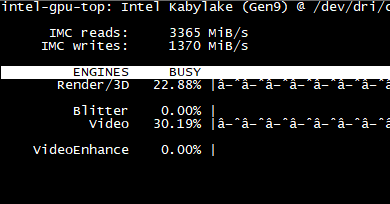


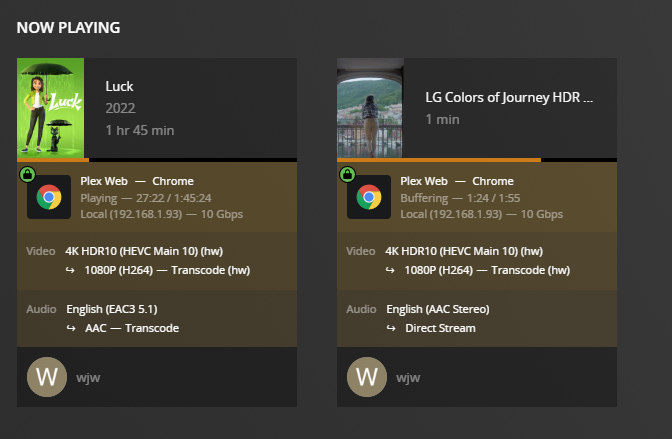
Thanks for your help… I guess we’ll never know… 
If it’s working now but didn’t work before then one of the runtime libraries was messed up.
Don’t forget to uninstall the Intel Compute Runtime libraries you don’t need.
If not sure – leave them.
Now that you guys solved this, may I go slightly off topic? I’m curious how many simultaneous transcodes did it take for you to need a ramdisk?
This made me realize when I’m load testing PMS that reading the transcoded data could be the bottleneck.
You will run out of capability of the CPU and QSV ASIC long before you need a ramdisk.
A typical HDD is good for 200 MB/sec == 2000 Mbps
The max QSV bitrate (for all simultaneous transcodes), on a KabyLake, is 600 Mbps
Converting audio on an i7-7700 is approx 12%.
6 x 100 Mbps video transcodoes = 600 Mbps
6 x 15% CPU to convert audio = 90% CPU
6 x 100 Mbps video + Audio (for the streams) ~= 100 MB/sec disk i/o
Ramdisk is not necessary.
I needed a ramdisk as pre 4K I had Plex running as a VM on an ESX cluster with iSCSI storage. Contention on the iSCSI was causing issues when we had more than 4 simultaneous transcodes running.
As ChuckPa said, you shouldn’t need it if your transcoding is local.
If you’re running a cluster, you better have a network which can handle the traffic.
The transcoder runs within the confines of the “Host”. If you have that in a cluster, your network must handle sliding that “Host” around the network to the next Physical Node which is actually running it.
No matter what you do, it must be 100% transparent to PMS.
