繁体中文在除大陆外所有华语地区被使用,繁体中文也不是源自于台湾的中文,为什么系统会称其为台湾语?
The Traditional Chinese is used in all Chinese areas like Hongkong, Singapore, Taiwan & etc, and Traditional Chinese is neither originated from Taiwan area, why system call it Taiwanese? this is so wrong!
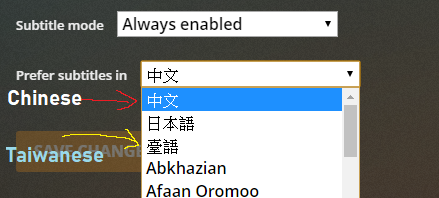
Could you please show a screenshot
or name the context where this description appears within Plex?
If it is in a Plex software, please name the client type and the menu item.
Would you say that 正體字/繁體字 only refers to a set of glyphs and a method of writing the chinese language?
As opposed to stating that “Traditional Chinese” is the name of a language that is spoken in Taiwan, Macau and Hong Kong and a few other areas?
Can you tell me what language code is used inside of commonly used video files, to denote the different versions of the chinese language, of the audio tracks and the subtitle tracks?
Is there a need to use different language names for the language of the Plex user interface
and the languages which are used in audio tracks and subtitles?
As of right now, “Chinese” in Plex means both Traditional and Simplified Chinese. Sometimes there’s a difference (like the UI language preference in some clients), but more than often there’s only Chinese, resulting in a mixture of both Chinese in the same environment…
Traditional and Simplified Chinese are so different, that most of the characters are written in completely different patterns. Let’s show this problem with an example. The word “dust” is written as “塵” in Traditional Chinese, whereas in Simplified Chinese is “尘”. As you can see, they mean the same thing. However, they are only meaningful in their respective written language.
To make matters worse, some SC characters can be translated into more than one TC characters. An example of this would be the SC character “干”. It can be translated into TC character “幹”, meaning “do”; or “乾”, meaning “dry”. Now imagine this being in your interface, in the metadata, and in the subtitles. It makes the whole enjoyable experience annoying.
Right now in some situations (like in picking preferred subtitles languages), there are “中文” (Chinese) and “臺語” (Taiwanese) as options. Though I appreciate the thought, this is not the precise representation of the difference between SC and TC. Chinese as a whole is a written language that exists in two forms as SC and TC. SC is mainly used in Mainland China and dominantly among Southeast Asian Chinese. TC on the other hand is used in Taiwan, Hong Kong, and Macau. Some people can make the translation between the two on the go, some don’t. Chinese is not a precise representation of a spoken language too. In China, people speak in Putonghua while the people of Taiwan speak in Mandarin. They are mutually intelligible, like British and American English. People in Hong Kong and Macau speak in Cantonese, an entirely different dialect to Putonghua/ Mandarin.
Sorry for the essay, but knowing all these we can finally head to the real issue: How should the language Chinese be presented as options in Plex? The simple answer is TC and SC. As I said before, there are just two written forms of Chinese. So there should only be TC and SC UI, metadata language, and most importantly, subtitles languages. For SC writers, they would prefer SC subtitles, whereas TC subtitles would be preferred by TC writers. Therefore, scrap the “Chinese” and “Taiwanese” and replace them as “Simplified Chinese” and “Traditional Chinese” and make everyone happy.
The language codes for Chinese subtitles are .zh and .chi. Again they both stand for Chinese but didn’t specify which written forms. I suggest that we follow the exercise the Chinese users adopted, by either marking it with a “t” or an “s” or with area notations. For the first convention, we would name them .cht and .chs for Traditional and Simplified respectively. A similar practice of naming them .zh-Hant and .zh-Hans is for the same purpose. For the second convention, we often mark them as zh-CN (China), zh-TW (Taiwan) and zh-HK (Hong Kong). I would recommend going for the first option as it would keep things simpler.
So there you have it. By implementing this, you would certainly enhance the Plex experience for many Chinese users.
I found this thread as there have been some older posts asking about labeling audio streams [中文 (AC3 Stereo) ], for all types of chinese .
The streams are labeled with the ISO 639-2 Code (zh-cmn, zh-yue, zh-tw for Mandarin, Cantonese, Taiwanese Mandarin) but they all show up as 中文.
It seems like Plex reads the language tag correctly, but doesn’t differentiate between the chinese dialects. Might it be easier for Plex to have the option of using the language that is labeled (as seen in a VLC audio selection dropdown)?
Thanks!
It seems impossible to fetch any metadata in Traditional Chinese too. Talk about frustration ;(
