Please go easy on me: I’m going to overthink everything, haha.
A while back I bought a cheap Lenovo mini PC with an AMD Ryzen 3 PRO 2200GE. I’m running Ubuntu on it partially because Windows 11 is not supported on it, but also because I like messing with Linux.
I’ve decided to run Plex on it recently, and read that AMD support isn’t strong with Plex, specifically with transcoding. I’ve heard the support is better in Linux, and seeing the decent Passmark score, I figured it would be fine, but wanted to check with the community if this was the case. I stream some movies and TV shows daily, some DVD quality, some compressed Blu-Rays so I would imagine most is not being transcoded, as well as live TV viewing and recording occasionally, but very seldom simultaneously. With this use case, should the AMD be fine, or is Intel the way to go?
If you do not transcode, then a Raspberry Pi could be a decent Plex server.
If you have to transcode, then you would likely want to look into Hardware transcoding, and I do not know what the status of AMD HW transcoding is at. But if you use software transcoding, then it is the CPU that matters, and it’s Passmark can give you a general idea on how efficient your CPU is at doing that. Last I heard, I think roughly for every 1000 passmark score is one software transcode at 1080p. I don’t know if Plex can multi-thread, so based on your CPU single-thread passmark, you could do about 1-2 transcodes in software.
Doing a quick AI search, it seems they may have finally added AMD Ryzen HW support, and it claims this specific card can be used. If that is the case, then you could potentially do a dozen or more streams, I believe.
Unfortunately you’re going to receive very out-dated responses..
AMD is fully supported for hw transcoding, in windows and linux. This has been the case for some time now and it works very well. whether or not it’s as good as intel quicksync I can’t speak to. The default response is “quicksync quicksync quicksync…” but there really haven’t been any tests that show conclusively that a plex server running an i5-12600 (for example) with the UHD770 iGPU is supporting more simultaneous transcoding streams than a newer ryzen 7-9xxx cpu. I can say with experience that a ryzen 5 7600 SHREDS an i9-9900 in terms of transcoding capacity..
folks talks about using an 8th gen intel as being great! they also praise the nanos for their energy efficiency.. sure, those (along with a rasberry pi) will support local direct streaming, but for transcoding a remote stream (or in my case 3-4, 1080P h.265 down to 720P H.264, with the “make my cpu hurt” setting), I can’t see how they’d be anywhere NEAR as good as the current gen of ryzen (or even last gen).
I can’t even find info on how a ryzen 7/8/9th series even compares to an intel ix 12xxx. folks just default to “quicksync”.. i have win10 IoT LTSC running on a ryzen 7 9700x and it HW transcodes to remote clients all night long (granted, it’s transcoding 1080P video to 720P, so it’s nothing too crazy). but the iGPU is working and it all works great. (would LOVE to see how it works on debian headless..)
The question i would like to know is how a ryzen 8700G (with the integrated 780m iGPU) transcodes compared to an 12th gen intel or one of the ryzen 7000 or 9000 series cpus.
If you’re not sharing out, or running a lot of concurrent streams, I’d say stick with what you’ve got unless you notice it’s having issues. Plex needs surprisingly little to run, even if it does have to transcode for 1080. My very first Plex server was a totally outdated AMD based box and it handled two streams inside the house just fine.
Upgrade if you notice it’s struggling to meet your needs, but I suspect you’ll be fine.
Windows: AMD is supported “as-is.” Unsupported for HEVC encoding. Plex specifically recommends using Intel QuickSync or Nvidia.
Linux: Supported for SDR transcoding. No HDR transcoding/tonemapping. No HEVC Encoding.
Plex has support for AMD GPUs on the roadmap. There is no published timeline. There are items in front of it: a) Public release of the new transcoder (currently in beta), and b) Updating Intel drivers on Linux to support Battlemage GPUs.
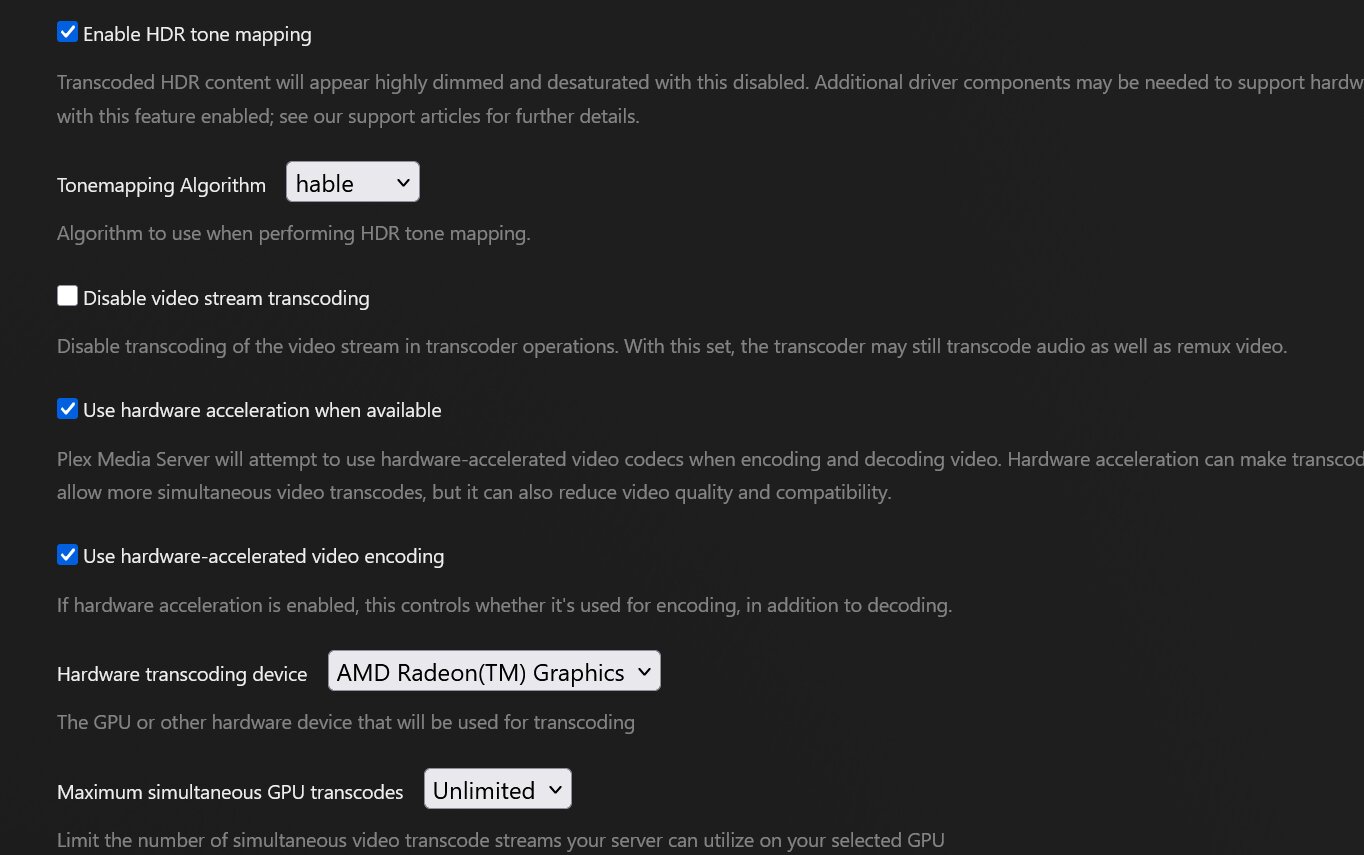
that was the case a while ago but plex has since updated the ffmpeg engine to the upstreamed version some 2-3 versions ago which supports amd’s vce for transcoding and HDR tonemapping. The settings and a list of tonemapping algorithms are there to choose from. I know it works for me as I see it whenever someone streams remotely.
As for transcoding to HEVC, yes that is still experimental, and it says so on the config page, but as for the good ‘ol transcoding (converting a high-resolution format to a lower resolution format in hardware), it is fully implemented.
The updated transcoder, based on FFMPEG 6.1, is in the 1.43.0 beta releases. It is not available in earlier releases.
Works ≠ supported.
From the documentation:
*Note: Our hardware-transcoding system has technical support for many dedicated AMD graphics cards, but we haven’t done official, full testing on those. Support for AMD GPUs is provided “as is” and your mileage may vary. It is recommended that you use Intel Quick Sync Video or a dedicated NVIDIA GPU.
Yes, that was quite a bit of time ago. They probably just haven’t updated their documentation to reflect it.. too busy making a mess outta the roku/plex UI..