Mixed.

I don’t really control WHAT I get.
ALL the files?
That’s only cuz I am too lazy to specify the individual files 
I just do this from the logs directory:
tail -F *.log PMS\ Plugin\ Logs/*.log
=> Plex Media Scanner.log <==
May 23, 2019 16:01:00.237 [0x7ff388eb6740] ERROR - Error issuing curl_easy_perform(handle): 28
May 23, 2019 16:01:00.238 [0x7ff388eb6740] ERROR - HTTP 408 downloading url http://127.0.0.1:32400/library/changestamp
May 23, 2019 16:01:00.238 [0x7ff388eb6740] ERROR - Exception inside transaction (inside=1) (…/Library/Episode.cpp:187): Unable to allocate a changestamp from the server
May 23, 2019 16:01:00.238 [0x7ff388eb6740] ERROR - Exception inside transaction (inside=1) (…/Library/MetadataItem.cpp:3424): Unable to allocate a changestamp from the server
May 23, 2019 16:01:00.238 [0x7ff388eb6740] ERROR - Exception assimilating media item in My Little Pony- Friendship is Magic/Season 7: Unable to allocate a changestamp from the server
May 23, 2019 16:01:05.248 [0x7ff388eb6740] ERROR - Error issuing curl_easy_perform(handle): 28
May 23, 2019 16:01:05.248 [0x7ff388eb6740] ERROR - HTTP 408 downloading url http://127.0.0.1:32400/library/changestamp
May 23, 2019 16:01:05.248 [0x7ff388eb6740] ERROR - Exception inside transaction (inside=1) (…/Library/Episode.cpp:187): Unable to allocate a changestamp from the server
May 23, 2019 16:01:05.249 [0x7ff388eb6740] ERROR - Exception inside transaction (inside=1) (…/Library/MetadataItem.cpp:3424): Unable to allocate a changestamp from the server
May 23, 2019 16:01:05.249 [0x7ff388eb6740] ERROR - Exception assimilating media item in My Little Pony- Friendship is Magic/Season 7: Unable to allocate a changestamp from the server
yeah it continues that way… nothing but errors
Well that all looks like more of a problem with your PMS install/Server setup rather than gDrive issues.
Not sure how to fix that, sorry
That’s what sucks. It’s a fresh install.
I’m going to delete all libraries and load it up and see what happens
@blim5001 @Xhaka I deleted all libraries last night, added back 1 library after running an optimize DB and bundle clean. This is what the past 12 hours looks like.
So… I’m using those vfs parameters. I changed my dircache time from 6000+ hours to 6 hours, thinking that shouldn’t be harmful since the PMS only scans every 12 hours, and the automation directory replication happens a few times a day or hourly, can’t remember as I’m not on my home network, haven’t bothered fixing my vpn and it’s ip-locked to the home ip.
Thoughts? Ideas?
While there are some errors, it does not look too bad, at least to me.
If you change the range for the graphs to 7 days does the last 12 hours look better
But is Plex working ok? Has it got all the metadata and images for the library you scanned.
Are you still seeing all those errors in your log files?
Can’t get at that - working extra-remotely at the moment. When I get home and have direct access I’ll ping you with results.
Is your configuration monolithic? Mine requires 3 separate servers. Automation, PMS, seedbox.
Yep, this latest set up is simply a 14 Euro seedbox that takes care of everything.
Downloading, Uploading, Sonarr, Radarr and most importantly streaming.
Just to add …
This is exactly the point I was trying to make with my first reply in the thread.
Something is very very wrong in your system somewhere, be it hardware or something else. There is no reason ever to need all Gdrive accounts doing different things.
I have no idea what that Plex update script is or what it does. It’s the first time I have heard of it in my 8 years of Plex.
Beyond that the only thing else that springs to mind is your Debian OS.
My dedi always ran Ubuntu and so does this current seedbox.
Alright. I’ll give you a simplified version, and the why of it all.
Because of my initial error account, and being a GSuite subscriber with 5 licenses, I went ahead and called Google support because I can. They said that the error looks like because the different clients are all authenticated with the single account and thus subject to these quotas: 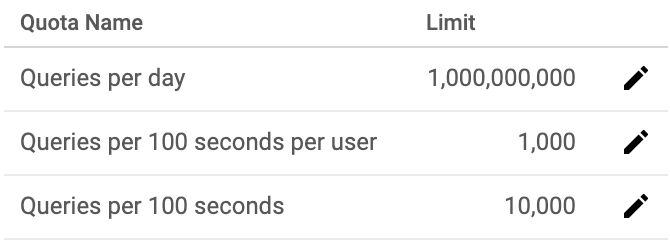
This is when the Google Drive team said I should use my additional family member’s accounts to each be one of the clients so that the user quota is never hit.
I don’t want to build a local storage server - too much upfront cost. Where I’m moving to next month offers bi-directional gigabit connections, so I will just continue to support a cloud-based format with a local rendering server leveraging the capability of however many cores I want to dedicate to the PMS virtual machine - all in the name of supplying the 8 users (including myself) with a solid streaming experience.
I’d just like to throw in there that the cost of all this is the same as a family-sized Netflix subscription, so considering I am pulling shows from all major networks and streaming services, it pays for itself.
The only reason I’ve had problems is because I migrated from Dropbox for Business to GSuite. Dropbox didn’t give 2 damns about API rates or storage usage or bandwidth usage. That was nice, but GSuite helps me in other areas. Thus the migration pains that I’m seeking the help here for.
I very much welcome your input on this configuration. My goal was for all piracy educational servers to be independent of my crappy Charter connection which has a total upload capability of two cans connected by a string, with only moderate download speeds.
So can I ask is there any reason to run Plex in a VM on the Dell.
That would definitely be the first thing I investigated.
Yeah i get that but it doesnt change the fact that if you need to do it then something is wrong
I have 85TB of media.
450 shows, 1800 movies all loaded in Plex.
Around 120 of those shows are loaded in Sonarr and around 300 of the movies loaded in Radarr.
Thats a lot of scanning going on and still a flatline on api errors.
I know we mentioned Plex thumbnail generation. What about Sonarr/Radarr?
Do you have Analyze video files disabled?
Or course! First of all I don’t know what your knowledge level on hypervisors is so I’m going to spell this out at a pretty low level, it’s not a hit at your intelligence I swear. I just want to make sure that everything is understandable.
My home network is basically three components. The server, a Cisco 28-port POE switch, and a ubiquity unifi pro wireless access point.
The server is self is pretty redundant. Like I said it has eight hard drives that are in a hardware raid 10 array, it has two power supplies, two six core CPU sockets, and two network cards. One network card has four ports and the other has two. The one with two ports is for internet connectivity and administrative connection to the ESXI host. The internet port is a pass-through that goes from my cable modem and it is given directly to a Sophos XG firewall. The administrative port is just there so that no matter what is ever happening I can always reach the administrative web console. The four-port card is active active active active and the hypervisor routes traffic intelligently over those four connections so that there is no bottleneck. also if one of them were to fail or if one of the four ports that it’s connected to on the switch fail, I lose nothing.
In addition to running a fairly closed operating system firewall, my wireless access point requires a software controller. I run this as a separate Debian virtual machine. This leads to why Plex is a virtual machine. it’s just the way I manage my home network. I used to have dedicated boxes for everything but the electrical cost of that and the mechanical maintenance cost of it was just too high. Also it generated so much heat.
As for analyze yes, that’s disabled across the board.
I forgot to mention; snapshots. I can take a snapshot of a system, test things out and if they don’t work for me, revert to pre-snapshot. If they do, I can just ‘merge’ the images. This does not degrade performance on something the scale of a personal server, not noticeably.
Of course sometimes you just have to blow away the OS because things happen.



